
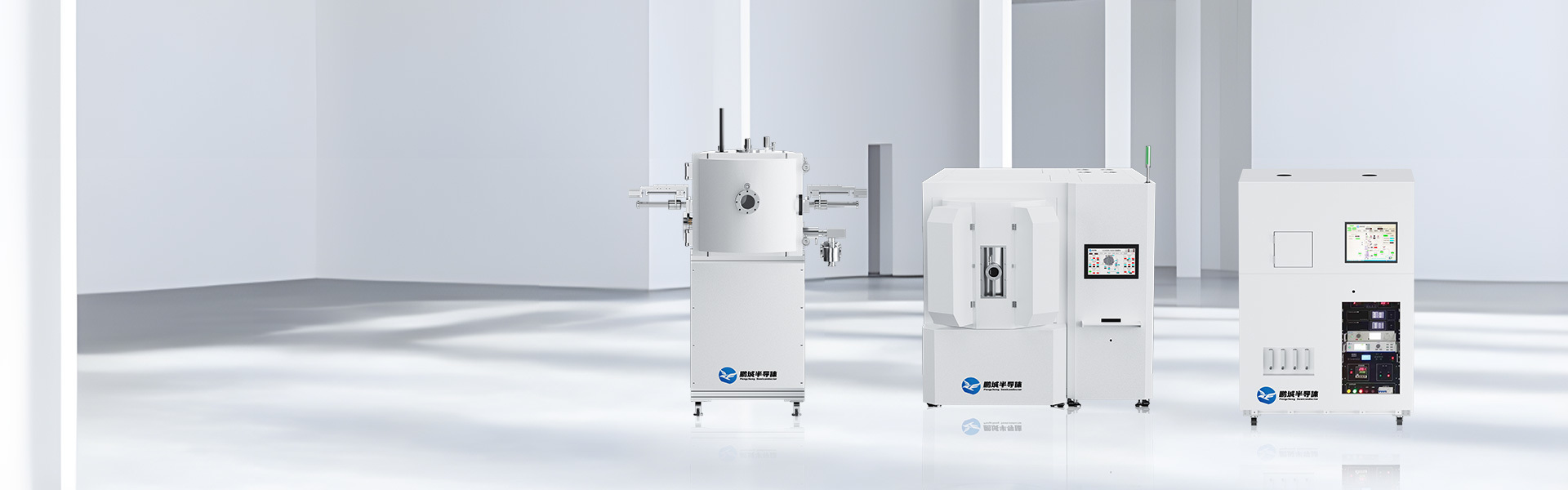

Research-oriented high-vacuum magnetron sputtering coating machine
The Circular Sputter series of research-oriented, high-vacuum magnetron sputtering coating machines are our company’s high-vacuum magnetron sputtering instruments designed for both research and pilot-scale applications. These machines primarily employ circular magnetron sputtering targets to deposit metal, alloy, compound, semiconductor, ceramic, dielectric composite films, and other chemically reactive films. They are suitable for preparing various single-layer films, multilayer films, doped films, and alloy films, and can be used to coat both magnetic and non-magnetic materials.
- Product Description
-
Research-oriented high-vacuum magnetron sputtering coating machine The Circular Sputter series is our company’s high-vacuum magnetron sputtering coating equipment designed for research and pilot-scale applications. It primarily uses 2- to 12-inch circular planar magnetron sputtering targets as well as small rectangular targets for sputter deposition. This equipment can be used to prepare composite films made of metals, alloys, compounds, semiconductors, ceramics, dielectrics, and other chemically reactive materials. It is suitable for depositing various single-layer films, multilayer films, doped films, and alloy films, and can coat both magnetic and non-magnetic materials.
Suitable for R&D of advanced packaging for TGV/TSV/TMV, featuring deep-hole metal seed layer plating with a high aspect ratio (≥10:1).
Key Technical Features of the Equipment
Guided by the principle that equipment provides the means to realize processes, we have carried out the following design and engineering implementation. The actual operational results have been excellent, offering users a precise process equipment solution tailored to their specific process requirements.
Bonding treatment between the back side of the target material and the surface of the sputtering target
- It is very difficult to achieve direct surface contact between the target material and the target surface. If surface contact cannot be achieved, the contact resistance will increase, resulting in an insufficient amplitude of the ionization electric field (as the contact resistance rises, the voltage division across the contact surface increases), which in turn leads to poor coating performance. Moreover, the increased resistance causes the target material to heat up, thereby degrading the quality of the coating.
- Poor contact between the target material and the target surface leads to inadequate water cooling, thereby reducing coating quality.
- Add a thin, soft layer of a special conductive and thermally conductive material to ensure surface contact.
Adjustable distance
The distance between the substrate and the target material is adjustable to meet the distance requirements of different target materials for film deposition processes.
Adjustable angle
The magnetron sputtering target head features an adjustable angle, enabling precise control over uniformity for substrates of different sizes.
Integrated cabinet-style structure
Advantages of the integrated cabinet structure:
Good safety (the operator won't come into contact with high-voltage components or rotating parts).
It occupies a small footprint, with dimensions approximately: 1100mm long × 780mm wide (the standard office door is 800mm wide). (Traditional equipment typically measures around 2200mm × 1000mm.) In the same-sized workspace, two units can be placed side by side.
Control system
A two-level control system employing a computer plus PLC.
Security
- Detection and Protection of Power Systems
- Set up vacuum detection and alarm protection functions
- Temperature detection and alarm protection
- Pressure and flow detection for the cooling water circulation system
- Detection and alarm protection
Gas uniformity technology
The process gas utilizes gas distribution technology, resulting in a more uniform gas field and a more even coating.
Substrate Heating Technology
An armored heating wire is used. Since the metal wire, which is heated by electric current, is not exposed inside the vacuum chamber, it does not release impurities during high-temperature heating, thus ensuring the purity of the thin film. The armored heating wire is placed in a temperature uniformizer to ensure even temperature distribution before the substrate is heated.
Higher vacuum level, faster pumping speed
Both inside and outside the vacuum chamber, all surfaces undergo electrochemical polishing, completely eliminating the microscopic burr “forest” visible under a microscope. There are no microscopic crevices or hidden harbors for dirt and contaminants to accumulate. As a result, the inner surface area of the chamber is reduced by more than half, leading to purer coatings, higher vacuum levels, and faster pumping speeds.
Equipment Structure and Performance:
1. Single-coating chamber, dual-coating chamber, single-coating chamber + sample-loading chamber, coating chamber + glove box
2. Number and type of magnetron sputtering targets: 1 to 6 targets, circular planar targets
3. Target installation positions: from bottom to top, from top to bottom, at an angle, or laterally.
4. Magnetron Sputtering Targets: Compatible with RF, IF, DC Pulse, and DC power sources.
5. The substrate is rotatable, heatable, liftable, and capable of being biased with an applied voltage.
6. By introducing the reaction gas, reactive sputtering deposition can be performed.
7. Operation modes: Manual, Semi-automatic, Fully automatic
8. If a higher base vacuum is required, a LOADLOCK should be configured, along with an ultra-high-vacuum magnetron sputtering target. Sample transfer should utilize a foldable system, an ultra-high-vacuum robotic arm, or a vacuum robotic arm. The system’s ultimate vacuum can reach 10. -8 Pa
Main Technical Specifications of the Equipment
- Substrate holder: Configured according to the size of the parts supplied.
- Substrate heater temperature: Configured according to user supply requirements. The temperature can be controlled and adjusted via computer programming.
- Substrate rotation speed: 2–20 revolutions per minute.
- The substrate holder is heated, rotatable, and adjustable in height.
- The distance between the target surface and the substrate is adjustable from 40 mm to 140 mm.
- 1 to 6 flat, circular targets ranging from Φ2 to Φ12 inches, equipped with a pneumatic target control panel; the targets can be tilted and their angles adjusted.
- Ultimate vacuum of the coating chamber: 6 × 10⁻⁶ Torr -5 Pa~7X10 -8 Pa, restore the working background vacuum to 7×10. -4 Pa: About 30 minutes (new equipment is filled with dry nitrogen)
- Overall leakage rate of the equipment: Vacuum level after 12 hours of shutdown ≤ 5 Pa.
Equipment operating conditionsType
Parameter
Note
Power supply
~380V
Three-phase five-wire system
Power
Configure according to device scale
Coolant circulation
Configure according to device scale
Water pressure
1.0–1.5 × 10 5 Pa
Cooling capacity
Configure according to heat dissipation.
Water temperature
18–25℃
Pneumatic component supply pressure
0.5 MPa to 0.7 MPa
Gas supply pressure for the mass flow controller
0.05 MPa to 0.2 MPa
Working environment temperature
10℃ to 40℃
Work environment humidity
≤50%
Key words:
Get Quote
Related Products



Contact: Miss Dai
Address: 1704, Building 1, Chongwen Park, Nanshan Zhiyuan, 3370 Liuxian Avenue, Nanshan District, Shenzhen City, Guangdong Province
Shenyang Office Address: Shenyang University Science Park, No.15 Wanghua South Street, Dadong District, Shenyang City, Liaoning Province
Telephone:13632750017
E-mail:sales@hitsemi.com

Message